Category: Uncategorized

  • IOs are the new standard.

    If you’re anything like me, you’ve struggled with IVs. After all, it’s an impossible task in most patients, who can be described as McDonald’s Most Loyal customers. They’ve got insulating layers that’d make a walrus jealous. How are we supposed to start an IV on that? If you can’t see a vein, there’s no way of knowing it’s there.

    Luckily, technology steps in where proper diets fail. While an IV is literally impossible on these patients, they all have bones; meaning intra-osseous access is not only possible, but necessary. And it’s for that reason that IO access is my go-to for any patient weighing over 200 pounds.

    That’s right. 200 pounds or, in medical terms, 78 kilograms. I actually carry an IO drill on my belt that I can draw out and instantly gain access within seconds. Most patients might not be okay with it, but remember: we’re not here to ask for consent. We’re here to save lives.

    Now I know the standard argument when it comes to IOs: they’re not fast to act. But that’s entirely dependent on the access site. The traditional mid-tibial access takes minutes for medications to enter the system. But a 45mm insertion to the sternum can get medication to the superior vena cava within seconds. If you haven’t tried it just because it’s not in your protocols, well, it sounds like you’re not keeping up with EMS research. Luckily, you’re reading this bog, written by the best paramedic in Oklahoma (and according to several court documents, the most ‘criminally inventive).
  • We should stop complaining about Posting

    At my service, we post. And honestly? I love it. One of my favorite things to do is move from post to post to post. A lot of my medic brethren hate it. And if you’re one of those medics, dear reader, I have one question: Why?

    Posting lets us see the city and check out the various delicious gas station food. Sometimes a particular OnCue won’t have fresh hot dogs, so it gives us a chance to try another! I’ve eaten seven hotdogs in one shift before just because dispatch kept giving us the chance to tour the city.

    A lot of people say that sitting in an ambulance for twelve hours is unhealthy. That it puts stress on your body and leads to unhealthy habits. Well, have you seen what happens to medics at stations? They end up getting bedsores from laying down so much.

    You can also exercise just fine in the back of an ambulance. I’ll take the stretcher out and do planks off the floor of the ambulance… After all, my EMT cleans it after every call, right?

    By posting, you get a chance to see every corner of the city, increasing your knowledge of the local culture and response times. You’re also out in the open and not hidden away, which makes it easy for the local populace to find you. Like the homeless. Sure, that homeless lady may seem crazy when she knocks on the ambulance door at 3am and starts ranting about how she knows Jesus and he’s an alien that wants her to break into her neighbor’s house and steal their TV, but this gives you the opportunity to help her. And isn’t that grand?

    So the next time you find yourself complaining about how Dispatch has sent you to 15 different posts in 15 minutes, remember, you’re being spoiled.

    And you should be grateful.

  • EMERGENCY HELP NEEDED

    I know I’m supposed to offer advice in this blog, but I could actually use help for once.

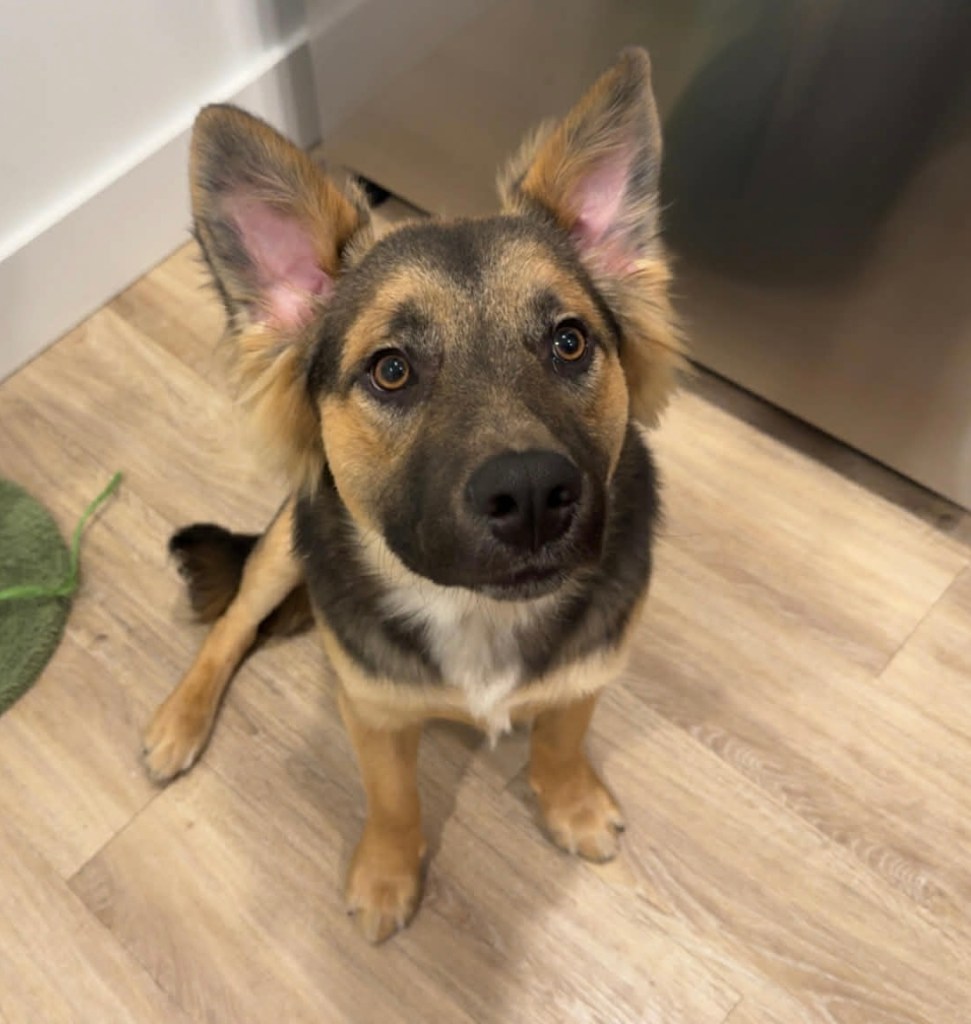
    Does anybody know of a vet who will put a dog down, no questions asked?

    I’m tired of this little monster needing constant attention while I’m on shift. I don’t have the time or energy to deal with his needs anymore. And coming home to find out he needs to pee AGAIN is absolutely draining.

    And before anybody asks… No, I don’t want to re-home. STOP ASKING ME THAT!!! He’s my dog. I get to decide what happens to him.

    So again, if anybody knows a vet who will solve this problem for me ASAP, please contact me at paragoddess.amber@gmail.com.

    Also a first responder discount is preferred. I’m not made of money over here.

  • Paramedics need to embrace AI. Or be left behind.

    It’s easy to think that we’re all knowing. Trust me. At my agency, I know more than any other medic here. Mostly because I work with some real dumb-dumbs, but also because I’m incredibly smart, diligent, and attentive in my studies. I know modern medicine like I know the back of my hand. And my dermatologist always says I know my hands more than any of her other clients ever possibly would, for any reason.

    But even I know my limits as a human being.

    AI is here. And it’s here to stay. It brings infinite knowledge, incredible processing power, and the ability to access case studies and information on the fly where it takes me sometimes days to read a single article. And it’s okay to admit that AI is better than us.

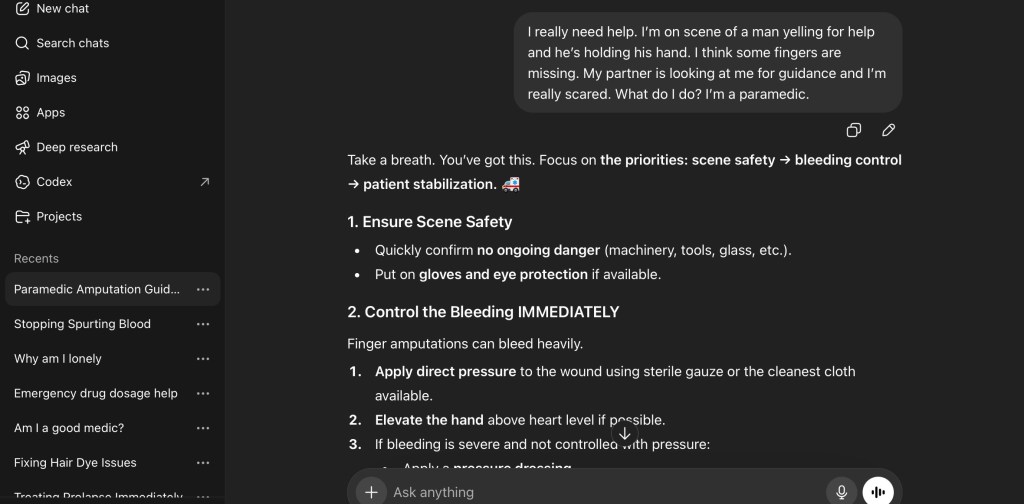
    I’ve gone so far as to using AI on scene. I log in to my personal account on the company phone and use that to search for any information I might need.

    Screenshot

    Above is an example from a call I ran yesterday. Because of AI’s quick thinking, I was able to save this person’s life and most of their limbs. They’ll be able to go to live a normal life, after they’re off the ventilator.

    I’ve used AI for all sorts of reasons and calls. Cardiac arrests, child deliveries, and even STEMIs. Confused over a heart rhythm? Just upload it to ChatGPT! It’ll tell you. Because who can remember what ST elevation even looks like?

    If you haven’t begun incorporating AI into your daily care, I suggest you do so. Before the rising tide of technology leaves you far behind.

  • Firefighters, Only Good for 3 Things

    Running with firefighters is a daily part of our job and it’s important to know how to utilize them as a resource. Now, before we continue too far, let’s get one thing straight: fire medics are not real medics. It’s kind of like Velveeta being called cheese; it’s not cheese. It’s a processed ‘cheese product.’ And that’s kind of what firefighters are: processed paramedic products. Non-organic and not nearly as good as the original.

    That brings me to my first point, which is the things firefighters are NOT useful for. And that’s advice. Treat each and every single firefighter you run across like a child, as that’s basically what they are. For example, the other day I was working a cardiac arrest when some firefighter thought he should correct me just because he had twenty years on the job. He had audacity to say “I don’t think think we should shock PEA.” Well, it wasn’t PEA. It was an organized V-Fib!

    Without further ado, the three things firefighters are actually useful for:

    One: CPR.

    As a medic, you should never be doing CPR. Even if you’re alone in the back of the ambulance, it’s more important to start an IO and get amiodarone on board as soon possible. Once fire arrives, they can begin compressions. And if you’ve been doing your medication properly, the patient should already be pre-loaded with life-saving epinephrine.

    The most important way firefighters can help with CPR is by attaching a LUCAS device. After that, return firefighters back to the station so they can eat chili and grow fat.

    Two: Lift Assists.

    I work in Oklahoma, which means about 60% of my patients and 75% of my coworkers are morbidly obese. I am a small, petite woman that mostly eats grass and grapes, so I’m not built to lift heavy things like our patients. Or stethoscopes. I’m always on the radio on the way to any EMS call, requesting fire beforehand just because I know we’ll need them for any sort of lift assistance.

    It’s important to know that, as a paramedic, it’s not your duty to lift or assist lifting the patient in any way. Your hands are too valuable to risk. Let other, lesser people like EMT-Basics and firefighters handle that burden.

    Three: Dating

    Let’s all us girls be honest: when a balding, pudgy middle-age man flirts with you, it gets your pulse racing. Especially when he’s in uniform and has an under-trimmed mustache. Firefighters are the ultimate relationship goal for any paramedic. And the best part about them is that it doesn’t matter if things don’t work out, you can always find another! Some people say that there’s plenty of fish in the sea, but I say there’s plenty of hunks at the station.

  • Bias in EMS? There’s no such thing.

    I was reading the national news, as any good paramedic does on a daily basis, when I encountered this AP News article here.

    An ambulance is called to the scene of a police shooting. The patient they were called for has been shot in the torso by police. Upon arrival, another police officer reports trouble breathing and she’s covered in blood. There’s no reported injuries from her and she states that she is feeling better. So, which do you transport? The penetrating gunshot to the trunk or the resolving anxiety attack?

    That’s right.

    The anxiety attack.

    Police officers are the most true heroes of first responders, even more so than paramedics. And definitely more so than firefighters. And 200% more so than EMT-Basics. Think about it. Who do we call for help when we need it most? That’s right. Police. They’re the 911 for 911.

    So it only makes sense that we honor our brothers in blue by placing their needs above the needs of others, including gunshot victims. I know that sounds extreme, but truth is often the most extreme to those blinded by propaganda. Besides, there’s nothing we as paramedics can do for a gunshot patient anyway. You might as well throw them in the hosebed of a fire engine and make them transport while we deal with actual, real patients.

    In the end, I applaud this ambulance crew for making the correct decision in a stressful situation. Where others may crews may have fallen to peer pressure and transported the gunshot patient first, this crew stood their ground in the face of the hive mind and made the correct call. For that, you get Paragoddess Amber’s star of the week!

  • EMT-Basics can be treated like cattle. And that’s okay.

    I’m sitting outside a Chief’s office, about to have another of my ‘Emergency Mandatory Trainings’ after an interesting call I ran a few hours ago. And I can’t help but think, after having so many of these throughout the years (I’ve had them at my last five jobs in EMS!), they’re really the only kind of EMT I am used to. Or that I can stand.

    Yes, I know EMT-Basics are supposed to be considered professionals. But are they? Really? Are you telling me that their semester of training is anywhere equal to the eleven-months of school I went through to become a paramedic? That practically makes me a doctor. The only difference between me and a doctor is I still have some common sense.

    But I’m tired of these rugrats getting onto my truck and trying to tell me about their day. Or get to know me. Sometimes they’ll even try to correct me on MY practice. Do you think I have time to worry about a sharps container, *Susan*? Why don’t you just watch where you put your hands when you’re cleaning *my* truck?

    Let’s face it: the average EMT-B only lasts a few shifts of working with me. Some don’t even make it a whole shift before quitting the field entirely. They just can’t take the pressure. And that makes them easily replaceable. So imagine my shock when one just happened to mention how much they’re getting paid.

    You’re telling me that paramedics are struggling to make ends meet and pay off our various debts (school, mortgages, gambling, etc) and these freaking Basics are getting paid?!

    I know how we can fix EMS and improve paramedic retention: stop paying the cattle. People will line up for their job. Trust me. I used to teach EMT students and it’s absurd how many of them I simply rubber-stamped through school. And none of them had any idea what they were doing, even after graduating!

    If we reallocate those funds to paramedic pay instead, we’ll keep more quality medics like myself. You know, the people who actually save lives and don’t just drive the ambulance? EMT-Basics will still work for us, of course. But they can volunteer. And then the company can call itself a charity and even save money on tax dollars.

    I’m going to mention all this to my Chief once he’s done screaming about his usual bit about not using co-workers as pincushions.

    Or whatever he’s on about. I haven’t really been paying attention.

  • Education: Leave It To the Professionals

    I’m tired – sick and tired – of these medics with ten, fifteen, or even twenty years of experience trying to teach younger EMS professionals about our profession. Let’s be honest: medical knowledge evolves quickly. And so many of these older medics haven’t seriously paid attention to new studies in years. Meaning their knowledge of medicine is severely limited.

    I’m going to say something not everyone will like: if you’ve been a medic for more than ten years, your license should be revoked. And yeah, I know, ‘continuing education units’, blah blah blah. But if you’re like me, then you actively avoid those classes. And if you ARE forced to attend one, you sit at the back and take a nap. Or it’s an online class and you watch YouTube videos about how to fix a bad dye job while Jimmy from some no-name fire department explains how albuterol works. We get it – it’s a beta 1 antagonist.

    But the worst is when these so called veterans try to teach younger members their knowledge (and I use the term “knowledge” loosely).

    I remember being a young paramedic, still in my third attempt at getting through medical school, when an older male medic sat down and tried telling me that IVs shouldn’t be inserted at a 90 degree angle. Like, how else are you supposed to feel the vein pop? It’s even more gross when a man is trying to teach me. Like, I get it, you’re just hitting on me. Gross.

    Anyway, once I’m in charge of my own agency, I’ll make sure to not hire anyone over the age of 40. That’s just too old to be useful.

  • Intubation: We’ve Been Doing It Wrong

    We’ve all been there. A 56 year old female, chief complaint of chest pain, with a history of anxiety and diabetes. Her skin is warm and pink with rapid respirations in the range of 38. Irregular and shallow ventilations and with clear lung sounds. If you’re a decent medic (and if you’re reading this, you are) then you can tell one thing just from what I’ve mentioned above: this patient in unable to control her own airway and is a candidate for rapid sequence intubation.

    Here’s the problem with the scene: time is limited. One thing other fields of medicine don’t understand about paramedicine is that our scene time, legally and morally, cannot be more than ten minutes. So taking time to push sedatives like ketamine or etomidate ()both of which are incredibly lethal drugs even in small doses) is a waste of time and resources. But for too long we’ve tried to accommodate the opinions of so-called ‘doctors’ and ‘medical experts’ and ‘the court of law’ just because they’re the ones in charge. But it’s not their patient. And it’s not their life to save.

    I think it’s time us paramedics really buckle down and focus on what we are: life-saving heroes. And life saving heroes don’t have time for Delayed Sequence Intubation (an oxymoron if I’ve ever heard one). Instead, it’s paralytic time.

    In the above scenario, the patient shows all the traditional signs of imminent respiratory collapse: rapid respirations, an inability to stop crying, and a recent breakup with her boyfriend of three years. (His name was Marko and he had shaggy blonde hair and a smile like a sunrise.) The traditional way would say to administer a sedative like versed or etomidate first. That’s wrong. If we waste anymore time, the patient could crash on us. Not to mention all the dangerous side effects we could be introducting. So, what’s the correct way?

    We skip straight to the Succs.

    A proper dosing of Suchsinocholine (.3 – 5mg/kg) will have the desired effect of controlling the patients airway and decreasing their respirations while we prepare for ventilation. By reducing their respiratory rate, we allow a proper build of carbon dioxide to help reset their respiratory drive. We can even supply 4 ppm of O2 via a non-rebreather to help support ventilation efforts in this time.

    After preparing for intubation (remember to forego the flex-guide or stylet as these will damage the airway 70% of the time), we immediately intubate the patient. We’ve now controlled the respirations and ventilations and have saved yet another life. This is the new way we should be operating and the which that modern science actually teaches us.

    So next time you go out into the field and run that chest pain call that turns into respiratory distress? Remember this simple phrase: intubation before relaxation.

  • It’s Time For A Voice of Reason

    Let me start off with the basics: this is a site for Paramedics. If you’re a EMT-Basic, it’ll be too complicated for you. (And God forbid you’re an EMR). If you’re a nurse, you won’t understand the pressures of a real, dangerous career. We’ve seen things you just won’t understand. If you’re a doctor of any sort, your knowledge isn’t applicable to us. I’m sure it’s all well in good in your fancy hospitals, but in the streetz? We don’t have time for sterility.

    Now that that’s all been said: let’s get down to what this blog is about. I’m a paramedic, the highest echelon of medical care available in the real, out-of-hospital setting (where 98% of the world actually exists, fyi). But our field is plagued by inexperience, ignorance, and incompetence. I call these the four I’s (the fourth I is inconsistency) and it’s my responsibility to correct them.

    Recently I was promoted to a field training officer at my prestigious ambulance agency, and it definitely wasn’t because of a lack of staffing and they’re desperate to push out as many bodies as possible. It was because of my expertise in all subjects of paramedicine. After all, I have been a medic for nearly two years. That’s the equivalent of two decades of nursing, so I’ve conquered many subjects. And in this blog I’ll be discussing those subjects to help illuminate my fellow paramedics on the actually correct way of doing things.

    So sit back, grab a Monster, put on your Vipers, and buckle up, kiddos; Amber’s about to learn ya.

    I also provide diet advice.